Family Memories
*
Family Memories *
My Granddaughter Abigail
Last Sunday, my wife and I went to a talent show at a theater in Topanga Canyon to watch my granddaughter, Abigail Crouse, belt out three songs with the vocal range and panache of Broadway headliner.
Abby is madly in love with show business. She is currently in rehearsals for three plays with three different theater companies in Topanga. All of her friends are theater kids -- passionately obsessed with acting, singing, and dancing. Abigail and her crew love to sing songs from Epic -- a musical adaptation of Homer's The Odyssey. She knows all of the characters from that ancient Greek text and can tell you their backstories and why she likes or dislikes them.
She also loves to draw and make miniature three dimensional sets out of construction paper that look strikingly similar to the ones produced by art departments on the television shows I have produced.
She loves to write essays and short stories. Her English teacher says Abby is writing two grade levels above her current 6th grade class.
Of course her preoccupation with drama could be a passing phase. And that's okay with me. I don't know what career Abigail will end up pursuing, but I am reasonably sure it will be a creative one. I take a great deal of pride in that because it is something I have been working on with her ever since she could walk and talk. I have said to my daughter and son-in-law many times: "If she has a creative mind, she will thrive in any field she pursues, from astrophysics to business to biotech."
I cannot take credit for all of Abigail's creative achievements in the 11 years she has been on Planet Earth. The lion's share of the credit belongs to Abby herself, but I think I made a contribution.
Our creative journey began with a gnarly piece of drift wood that sits in our backyard. When Abby was two I told her this was a Troll House and that many trolls lived there and deposited their treasures within. Then I would hide little shiny presents for her there -- figurines, Christmas ornaments, wrapped candy, etc. And I would tell her these were presents the trolls left for her. Soon, every time Abby came over she would say, "Grandpa, we go to the Troll House now?" Her eyes would bulge like a pair of golf balls every time she found a new hidden gem.
Then came our hikes down a fire road in Paradise Cove in which Abigail assumed the identity of her alter ego, Jungle Girl. I was her loyal attendant as she sat upon a tree stump throne and waved a pine branch scepter, dispensing proclamations to the squirrels and bunny rabbits that scurried past us.
There is a tennis court on that fire road with flowers planted around the chain link fence that encloses it. One day I said, "Let's go to The Grandpa Garden to see if any new Grandpas are blooming." Abigail gave me a quizzical look. I explained that this was where grandpas were grown by the loyal gardeners of Paradise Cove. In fact, I myself was grown there and ripened and was picked just before Abby was born. Her eyes widened as she scanned the flower beds for signs of a freshly blossoming Grandpa.
After that, on every hike Abby would say, "Let's go see if any new Grandpas are growing!"
One day a man in his 60s was playing another old man on the fence-enclosed tennis court. I cried excitedly: "There are two freshly picked grandpas!" I explained that after Grandpas are picked they are wild at first and must be kept in a cage until they are tamed. I myself had been kept in that cage for weeks just before Abby was born. Abby stared in utter fascination at the freshly picked Grandpas until the men grew self conscious and began missing shots.
We also rode in a golf cart all around Paradise Cove. One street runs beside a deep ravine filled with trees and bushes. I stopped the cart. "Look Abigail, it's Gremlin Gulch." Abby immediately wanted to go down and hunt for Gremlins. Once down there, as she peered apprehensively through the undergrowth, I said, "There's one! See his eyes in that bush, staring back at us!" She shrieked and ran back up the hill at record speed. But on a subsequent day when we drove past she urged me to stop and said excitedly, "Grandpa, can we go down into Gremlin Gulch?" And so we would repeat the whole psychodrama again and again and again.
I believe in puns. When I was growing up my father and I would engage in long pun riffs, each of us feeding off the other as we slung puns fast and furious. I did the same with Abby because I believe puns help you develop a sophisticated use of language. We would drive by a pair of deer statues on someone's lawn. I would ask, "Hey Abby, why do you think the sculptor created that deer with the antlers?"
She would say: "Because he wanted to make a buck."
"And why did he carve the female deer?"
"To make some doe."
Our golf cart also sped past a large concrete structure that's part of the septic system in Paradise Cove. I told Abby it was Pandora's Box, the one from which Pandora released all of the deadly sins that infected humankind. After doing this a few times I could say to her, "Abby, what's that structure?" She would answer that it was Pandora's Box and recite the entire myth to me. I like to think that her current passion for The Odyssey and Greek Mythology had its origins in those exchanges.
I also taught her another myth on those golf cart rides. Not a Greek or Roman or Egyptian myth, but a very specific myth that had been passed along through three generations of my family.
My father's father, William "Doc" Weddle, had been a dentist in McKeesport, Pennsylvania in the early 20th Century. I never met him because Doc died when my father was 12 and lay in an unmarked grave for 40 years until my father put a headstone on it.
Before Doc died, my Dad used to ride around the greater Pittsburgh area with him on the streetcars. Those streetcar rides were much like my golf cart rides with Abby. Doc passed along all kinds of folk lore and tall tales to his youngest son, Jimmy, and my dad lapped it up, his imagination blossoming with wonder. One of the tales Doc Weddle told his son was about The Birds That Fly Backwards. "Look up in the sky, Jimmy, keep your eyes peeled, and you will see whole flocks of them flying backwards, heading North in the winter. Do you know why they fly backwards, Jimmy? Because in order to know where they're going, they need to see where they've been."
This simple yet profound metaphor for how the past affects our trajectory into the future was then passed down to me by my father.
And years later I passed it on to Abigail. Every time I heard the squawks from the flock of green parrots that thrive here in Malibu I would point to them and tell Abby they were The Birds That Fly Backwards. And then I would explain why they fly backwards. Soon she could recite the myth herself.
When I wrote the memoir about my family, I asked Abby if she would draw a picture of The Birds That Fly Backwards for the last page of the book. It took her almost a month because she agonized on how best to portray them didn't want to let me down. She did not. Her picture is luminous and magical and triumphant. She drew it 100 years after my grandfather, Doc Weddle, first told the story to my father, who later told it to me.
That is the power of story telling. And a testament to its value.
Since the time she could talk, I have been showing Abigail classic films -- the silent masterpieces by Charlie Chaplin and Laurel and Hardy, and clips from early sound movies by the Marx Brothers and dancers and singers like Cyd Charisse, Ginger Rogers, and Eleanor Powell.
One time when I was at work I got a message on my cell phone from Abby: "Grandpa, I'm here at your house. I was going to watch Buster Keaton with you, but you're not here."
I showed her Groucho Marx singing, "Whatever it is, I'm against it," in Horsefeathers. And I showed her Donald O'Connor singing, "Make 'Em Laugh!" in Singing in the Rain. She watched silently but attentively. I was not sure if these musical numbers had any impact on her.
Until that Thanksgiving when Abby and her best friend, Sheila, announced they wanted to perform songs for all of us. To my astonishment, they sang "Whatever it is, I'm Against it!" and "Make 'Em Laugh!" without so much as fumbling one line of the lyrics.
Last year I was able to take Abby and her friends to see Singing In the Rain at the Aero theater. They came out of the screening singing the songs and proclaiming that Donald O'Connor's character -- Cosmo -- was their favorite. "Cosmo rules!" They yelled to passing cars.
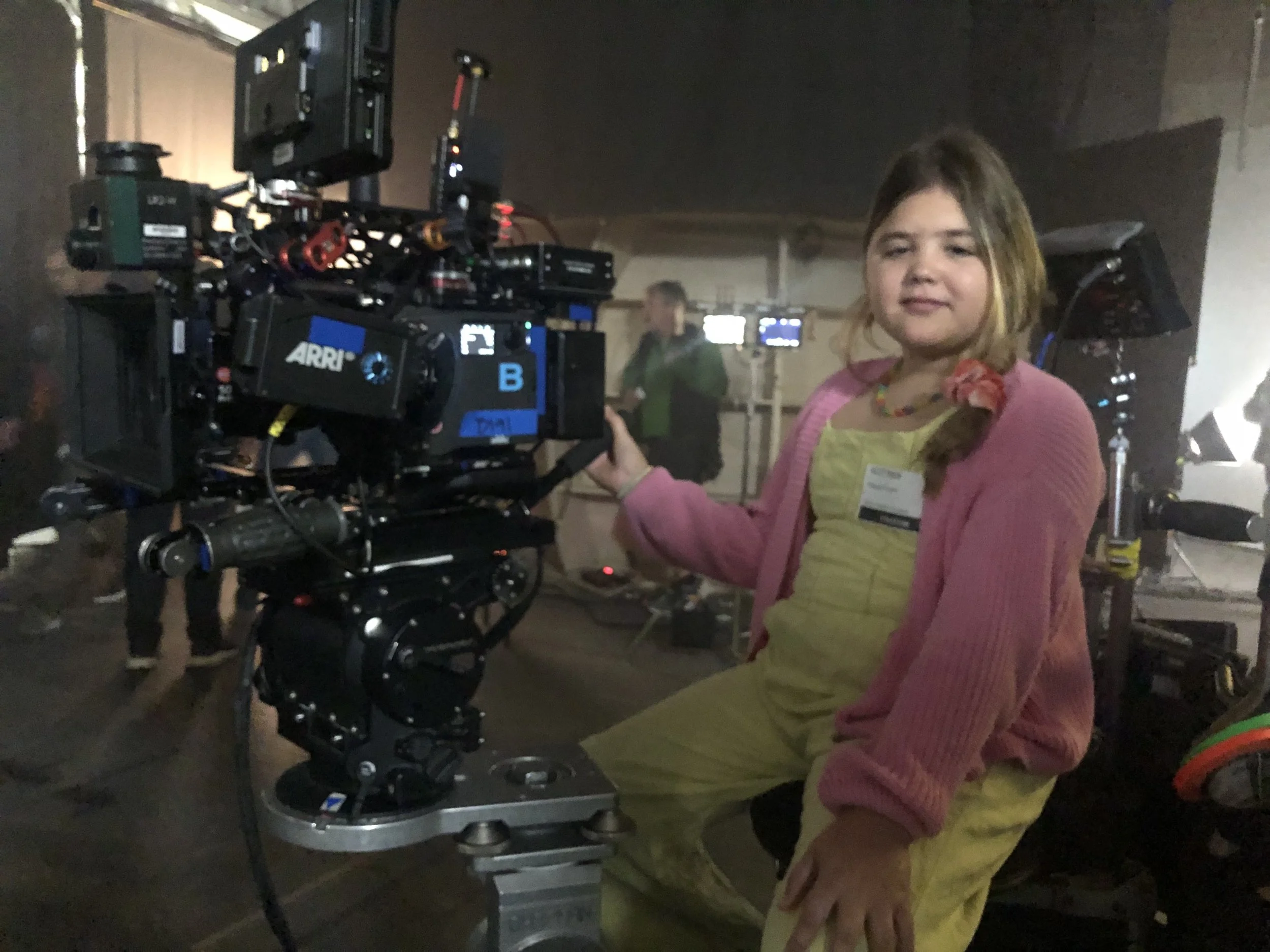
I brought Abby to Sony Studios to visit the inner workings of my Apple television series, For All Mankind. She toured the wardrobe department, hair and makeup, but it was the production design department with its miniature scale models of the sets made out of construction paper that most fascinated her because they were so similar to the miniature doll houses Abby built at home out of the same materials.
We took her on set while scenes were being shot and the crew was generous enough to allow Abby to climb onto a camera dolly to feel what it would be like to be a camera operator.
I also created a scene for Abby in the very first episode of For All Mankind that my partner, Bradley Thompson, and I wrote. In it, Molly Cobb becomes the first woman astronaut to fly to the moon. Molly is unprepared for how much this will mean to young women and is startled and moved when thousands of letters pour into the Johnson Space Center from girls who now see her as a role model. One of the letters is from a fictional character named Abigail Crouse. I wrote Abby's letter and Molly's response to it. There is a message buried in it for the real Abby: she can do anything she is bold enough to dream of in this life. Then I framed those script pages and hung them on the wall of Abby's bedroom.
She read the pages once and probably has not looked at them since. But they hang over her head as she lies in bed fantasizing about all of the things she wants to be when she grows up.
I think Abigail Crouse is an incredible young woman with a creative mind that seethes with ideas and plans and aspirations. She and others like her are the hope for our future.
Mom and Me
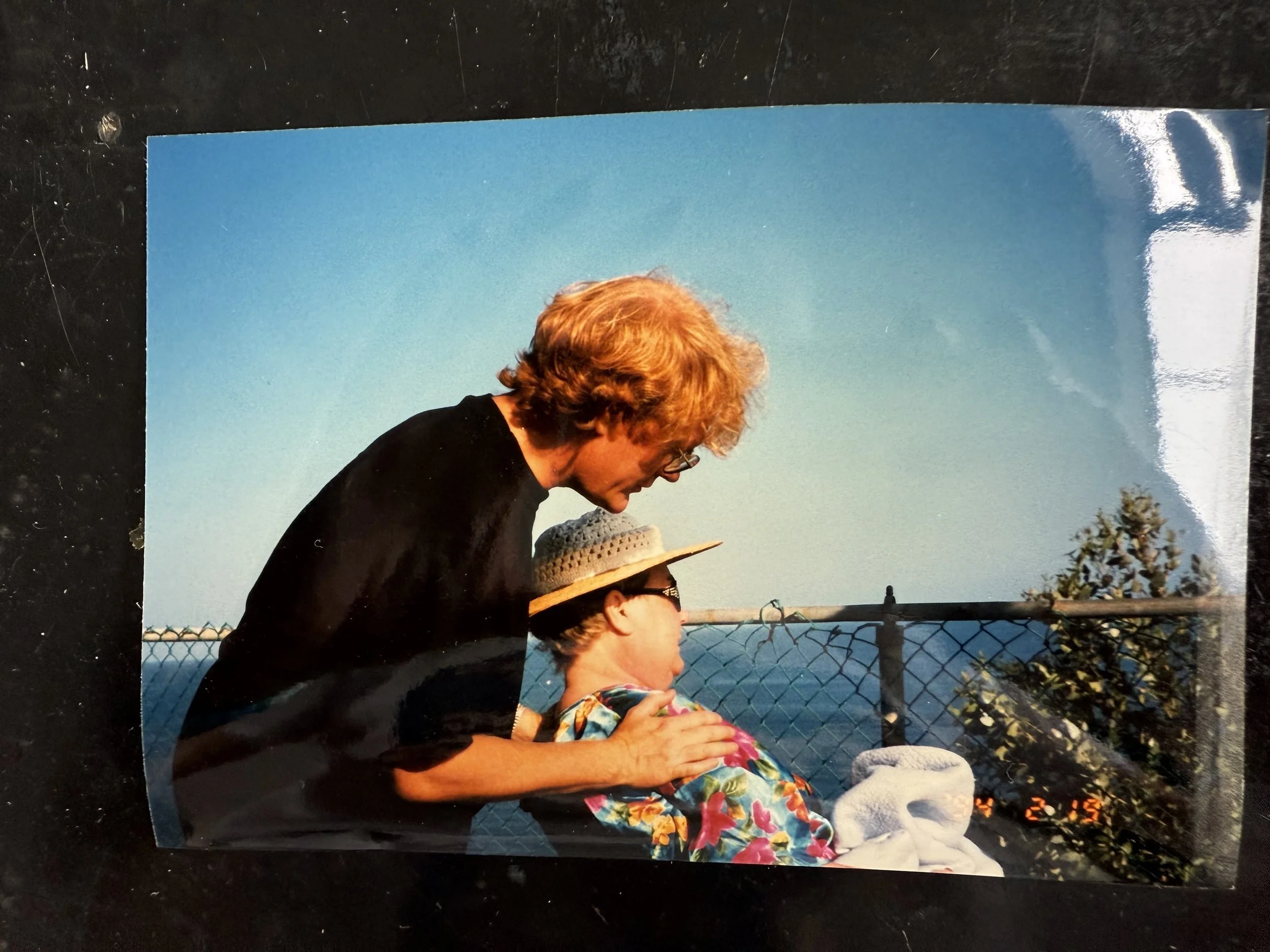
Every morning I walk my Labradoodle -- Kesey -- along the cliff here in Paradise Cove. We always pass my mother's bench. The one she sat on every day after she contracted a malignant brain tumor and was forced to come live with me. She would gaze out at the great expanse of blue water and say breathlessly, "It gives me such peace." You could feel the ocean loosening the kinks in her body and psyche as she breathed in the salt air.
I look out at the water today and think of her ashes swirling among the waves down there. Sometimes I talk to her. Especially on Christmas Day. She and my father shared a deep love of that holiday. Writing about it now I smell her scrambled eggs and sausages and coffee cake warming the kitchen on Christmas morning.
In home movies taken when my parents visited Hawaii and other tropical locales, my mother is frequently positioned at a window gazing out at the ocean in an almost trance-like state. My father -- taking the movies -- would always have to call out to her multiple times before she turned to face the camera with a slightly dazed expression.
The ocean triggered a spiritual experience for her that could not be translated into words.
It was my mother who took my hand when I was two years old and led me to the ocean for the first time. I was frightened but captivated. She gently explained there was nothing to fear as small waves broke over my smooth pale feet.
Then she sat me down and helped me dig for sand crabs. When she pulled one up from the subterranean depths and placed it writhing in my palm, I too was captivated by the mystery of this border region between land and sea.
When I was seven we moved to the then small beachside town of Corona del Mar, California. Mom drove us to the beach every Saturday of the summer in our hatchback 1966 racing green Mustang, which had a special button under the dash that made the car whinny like a wild stallion. My sister and I cavorted in the waves and caught crabs and starfish and small tide pool creatures, which we deposited in our tin pails. When it came time to go home, Mom gently convinced us to return the sea creatures to their natural habitat.
I moved to Paradise Cove when I was 32. Thirty-eight years later I live here still. Because of my mother. I consider it one of the great achievements of my life that I carved out a place for myself here in Malibu.
But my relationship with my mother was as plagued with ambivalence as the one I had with my father. It took a subtler form, but it was just as fraught.
All the time I was growing up and well into adulthood, my mother delighted in telling a story about giving birth to me. The nurse said, "Congratulations, you have a beautiful red-headed boy."
Mom's eyes popped with with disbelief. "A red head? No! That can't be. You've made a mistake. Not my son!"
She laughed with delight when telling this charming little anecdote. Never once did she concern herself with how I felt about being told I was a repulsive freak.
Then there were the episodes where my father's post traumatic stress from World War Two got the better of him and he would explode with rage. One time he hit me until I peed on his leg, then hit me for peeing on his leg. During all of the beatings Mom would stand there, bleating weakly, "Jim, that's enough. Stop Jim." She never placed herself between me and my father, never tried to pull me to safety.
After these episodes she would come to my room to explain the reasons for my father's outbursts. "He didn't mean it. Sometimes the stresses he's dealing with at work get the upper hand and he's not himself. He loves you very much. Always remember that." Then she would tell me about my father's Dickensian childhood. His father, whom he loved dearly, died when he was 12 and was buried in an unmarked grave. Dad was left in the custody of his mother who was so prone to violence she once opened a cut on his forehead with a mop handle. Dad had to go to a doctor to get it stitched up.
Mom's apology for my father's abuse would inevitably be followed by an apology from Dad himself. I'd hear him coming down the hall and would get ready for it, because this was a beloved ritual. He's come in and sit beside me on my bed and say how sorry he was for losing his temper. He explained that sometimes bad moods overwhelmed him so that he couldn't think straight. "It wasn't about you. It was me. You know that I love you, right?"
I wouldn't look at him at first. I kept my eyes averted and made him beg for it. "You understand, don't you? I love you and your sister and mother more than anyone else in the world. I'd be lost without you."
Finally, at last, I would look up at him and say yes, I understood. He would pull me tight and kiss me. I can still feel his beard stubble on my cheek, smell the cigarettes on his breath, and the Old Spice cologne on his skin. To this day, those rituals of forgiveness remain the most ecstatic moments of my life.
But it didn't make everything okay. It took years of therapy to come to terms with my anger at both my parents. At first the focus was my father, for he was the obvious monster. But over time therapists turned my focus to my mother (the good parent) and helped me realize I was also angry with her. Because she was the sane one. She knew better. And yet she failed to protect me.
It was not safe in my house to express anger directly to my father. Or my mother -- because Dad kept drilling it into my head that I must always respect her and if I didn't I would have to face him.
So I found more unique and creative ways to express my resentments. By stealing mail. Taking rocks and smashing the glass dials on all of the water meters in the neighborhood. Ruining two swimming pools in one day by pouring paint in one and filling another with dirt clods. Oh yeah, and I started multiple fires with matches.
It got so bad that one day when a house in our subdivision caught fire, Mom called me at the friend's house where I was playing and demanded to know if I had anything to do with it.
And yet Mom did most of the heavy lifting when it came to raising my sister and me. When I formed a burning desire to become a ventriloquist at age 10, it was Mom who ordered one from our beloved Sears Catalogue, along with an LP by TV ventriloquist Jimmy Nelson that taught me to throw my voice. I studied it for countless hours and became the hit of my Fifth Grade talent show, feeding my burgeoning love of show business.
I was a terrible student. I didn't see what school had to do with me or my world and the things I loved in it. Our playground was fenced in. I remember clinging to the chain link, gazing enviously at the adults strolling or driving by, free to go anywhere they wanted and do what they wanted.
I hated everything about school. Reading intimidated me. I was desperately shy. When asked to read aloud I choked. So they put him in the slow reading group.
Flash card exercises seemed to be specifically designed to humiliate me. Again, I choked.
My third grad teacher wrote on my report card: "David does not have a command of the English language. This is going to be a big problem for him in the years to come."
Mom never let me forget that assessment. She brought it up many times over the years.
I think she worried from very early on about what would become of me. I don't believe she had high expectations.
She pinned her hopes on my sister in those early years. Tracey was a straight A student and in a mentally gifted program. She was a swimmer and a gymnast who brought home medals. I was uncoordinated and displayed no interest in sports. I only excelled at destroying public property. Flushing an M-80 down a toilet and blowing it off a wall in a public park bathroom was another of my great achievements during this period.
On the other hand, Mom did not give up on me. She tried engage my interest in academics. In Fourth Grade they gave us writing assignments. Two page essays on United States or California history. To me, filling up those two pages seemed like being asked to write War and Peace. An insurmountable task. I would stall, until Mom brought down the hammer and forced me to sit with her and write the entire essay. So she was my first co-writer. My first editor.
She bought me a set of World Book Encyclopedias that came with a Learning Center board game that enabled you absorb trivia in a variety of fields. And she walked me through its intricacies. Afterward I played with it on my own, but probably not to the extent that she had hoped. I also broke open those World Books to read about the Roman Empire, World War Two, silent movies, and a wide variety of other topics.
Mom noticed my growing interest in World War Two -- nurtured by Dad's war stories -- and bought me a set of Time Magazine books that tracked the history of the entire war. For the first time I developed a sense of the war's scope and how it unfolded. I quickly became obsessed and read those books over and over.
None of this had an impact on my school work. Yet.
The real turning point came when I saw a production of Of Mice and Men on TV. A few days ago I posted an account of how I came to watch that program and its lasting effect on me. But in case you didn't read that post, I will give you a quick recap. I identified with the character of Lenny, the dimwitted child-man who is bullied by other ranch hands (as I was bullied by my father and by the big kids in school). But Lenny has superhuman strength and is able to crush the fist of one of his tormentors. Oh how I wished I had his power! More importantly, I was deeply moved by the friendship between George and Lenny and the loneliness George feels after he is forced to shoot his friend to save him from rapidly approaching vigilantes who intend to brutally murder Lenny. I was lonely too, and I felt George's isolation on a visceral level.
Somehow I found out there was a book that the TV show had been based on. So I went to the library and got it. From that day forward I was never without a book. Within a few weeks I wrote my first short story -- a blatant ripoff of Rudyard Kipling's Rikki Tikki Tavi. I brought the story home from school at read it to my mother and my sister Tracey at our pinewood kitchen table. My mother expressed great enthusiasm. I'm sure she felt a sweeping sense of relief that her son was at last starting to master the English language. But she would not have been relieved if she knew what it would lead to.
Because I wrote from that day forward. Every day. Reading and writing became my religion and 60 years later I am practicing it right now as I write this.
At first the effects of my new faith seemed positive to Mom. Within a year I was getting A's in many classes -- history, English, social studies, and biology, to name a few. I was not as consistent as my sister. If I was uninterested in a subject -- math, Spanish, French, art -- I barely managed to pass. But still, I was making great strides.
It wasn't until I announced that I intended to be a writer and to make movies that my mother's alarm bells went off. She thought this was an appalling development and tried everything she could to talk me out of it. She suggested I get a real estate license, or go to work for my father at his packaging plant, or sell insurance, like my half-brother, who was fantastically successful.
Unfortunately, she was no match for my father, who read every short story I wrote and watched every movie I made and offered much praise and detailed critiques. Dad would say, "You're going to make it! You have talent. You're going to ring the bell, the nose knows!"
Mom resented Dad's encouragement. She felt he was filling my head with pipe dreams and that it would only lead to failure and disillusionment. She wanted me to be happy, to get married, buy a home, and live a conventional life. After college when I was waiting on tables and polishing airplane hangar floors and emptying semi-trucks full of fiberglass insulation to earn a subsistence level living while writing plays that no one wanted to see, she believed my father had done me a tremendous disservice.
I recently ran across a batch of Christmas cards from that time. Dad's card was filled with encouragement. "This will be the year when you finally ring the bell. I can feel it! All of your hard work is about to pay off!" On her card, Mom wrote, "Well, hopefully this year will be better than last year."
In 1985 I decided to write a mammoth Thomas-Wolfe-sized novel about my father's Dickensian childhood in the rusted out steel mill town of McKeesport, Pennsylvania, just up the Monongahela River from Pittsburgh. Mom thought I was delusional to do this, even though she was the one who originally told me the tale of my father's youth and got me fascinated at an early age.
Ironically, my father didn't want me to go either. He was afraid I would discover that he did not graduate from high school and that he had been forced to join the Marines because he was a juvenile delinquent. But when he found out I was living on the street he was born on he put his misgivings aside and flew out to stay with me in my one bedroom apartment in a weathered mill worker's house. Dad slept on my bed. I slept on a Lazy Boy chair. A shower curtain shielded the window from the street.
Mom never came. Never commented on what I was doing.
But when I finished the 2500-page manuscript, a strange reversal happened. For the first time, Dad refused to read something I wrote. I think because it cut too close to the bone. The heart of the novel was his relationship with the father he idolized and lost at age 12. The wound inflicted by his Dad's death plagued my father his entire life. On his death bed he would still be talking about his long lost father. But Mom -- to my astonishment -- read all 2,500 pages. She was one of the few people to do so, because the book was an overwritten failure. I will have more to say about this in a later post.
But Mom persevered through Kevlar-dense prose to the very last page. Sometime shortly after that Mom and Dad and I went to dinner at the Five Crowns, the upscale steak house in Corona del Mar where we had all of our important family dinners. During the meal Dad held forth on how much he loved and admired my mother's father -- Nick Byrne, an Irish farmer who came to America to work as a gardener on the enormous Gilded Age estates on the Hudson River in Irvington, New York.
Dad often talked in glowing terms about Mom's father at family dinners. In part, I believe it was his way of trying to make up for hurting my mother so many times over the years. But he really did idolize Nick, I think because Nick had an inner calm and integrity that eluded my father.
On every previous occasion my mother would listen to the litany of praise with a tight stoic mouth and expressionless eyes. But this time -- after recently finishing my mammoth novel -- she fixed me with a piercing gaze and broke into uncontrollable tears. "I feel so guilty because I was ashamed of my father. Because he was just a poor gardener, pulling weeds on a rich man's estate."
It was a stunning moment because my mother was a enigma to me. In contrast to Dad, she revealed very little about her inner emotional life. Consequently, I felt remote from her. When I came home from college for a visit I would hug her and she would manically pat my back, as if I were too hot to hold.
The day after that dinner, she also said to me with a puckered mouth: "You are never to write about me the way you've written about your father. Do you understand?"
I just looked at her without responding, so I am not breaking a promise by writing about her now. I know it would displease her, but if she were alive to read every page of my four volume memoir about our family I think her feelings would change.
After my father died, Mom finally opened up to me as I had so longed for her to do. But when she opened up it was not to shed sentimental tears and utter facile bromides about love and loss. It was to spew forth for more than an hour about all the ways my father betrayed her. Chief among his crimes was fucking just about every woman he could get his hands on. Once at a party at a suburban home, Mom had to drag him out of some bushes in the front yard where he was fucking another one of the guests.
Listening to all of this, I became very upset. Mom had taught me to make excuses for my father, to rationalize his behavior, and now she pulled the rug out from under me. Mom said, "Well, you kept pressuring me to open up and express my real feelings." She went on to explain that she had never told me about any of this because she knew I loved my father and she did not want me to turn against him. She wanted to keep the family together and so she swallowed her feelings of betrayal for the sake of me and my sister.
It has become a cliche to portray women who make such choices as pathetic and weak. When it's discussed at all these days, the impulses that drove my mother's decisions are ridiculed. People say things like, "Your mother was too weak to face the world on her own." "She let your father treat her as a doormat."
There is truth in such conclusions. But Mom did keep the family together and there is no question in my mind or my sister's that this was good for us. The family economy was maintained, enabling us both to graduate from college -- something Mom and Dad never had the opportunity to do. It was good for my father, too. Because he would have spiraled into the ground if Mom divorced him, and never would have lived into his 70s. Mom knew this. And through it all she saw the tragic arc of his life, from his brutal childhood to the dehumanizing war and all of the inner demons he fought as a consequence. And she knew the reality: he needed her much more than she needed him. And when he was up, there was no person more fun to be around than my Dad. And Mom loved it when he was up. She used to say all the time, with a great deal of affection, "He's a Gemini. No question about it. He's two different people. But when he's in a good mood, there's no one else like him!" He was hilarious and unpredictable and she loved that about him. I think she looked around at the alternatives -- all those white bread Orange County Republican men in their flat-top hair cuts, Lacoste shirts, khaki trousers, and top sider shoes -- and she was... bored. Mom was addicted to the excitement of being around my father. We all were. The three of us went on many family vacations in our high school and college years and even afterward, and on them in we laughed and joked and had an all around ecstatic time.
It took courage to stay in the marriage. But she didn't see it that way. In her heart of hearts she wondered if she was simply a coward who was too afraid of ending up alone to make a clean break with my father. She was keenly aware of how the world -- including her friends -- viewed her for making such a choice and she bore a great deal of shame about it.
But in the decades since her death I have come to believe my mother had an abundance of courage. Not the blustering testosterone-fueled courage of my father. But a quiet courage that was not recognized by even her closest friends.
I saw that courage when she was diagnosed with a malignant brain tumor in 1994. My father had been dead for more than a year when she flew to New York City to watch me introduce a screening of Sam Peckinpah's masterpiece, The Wild Bunch. I had recently published the authoritative biography -- "If They Move... Kill 'Em!" The Life and Times of Sam Peckinpah -- which received rave reviews. When I stepped to the podium I received a standing ovation.
Afterward, my mother came down from her seat, her eyes aflame as she said, "I can't believe all of those people were applauding for my son!"
The triumph was short-lived because that night she became incoherent in her hotel room and the next day she was diagnosed with a Stage Four Glioblastoma, for which there is no cure.
When I broke the news of the diagnosis to her in the hospital room her eyes widened. "You mean I have a tumor growing out of my brain?" When I affirmed it, her mouth tightened bitterly. "Well, that's just great."
And yet, when I had to put her into an assisted living facility a couple of months later she adjusted with amazing resiliency. She never said, "Why me?" She never complained that she would not live to see her grandson born or see me get married to my then girlfriend, Risa Parness.
When Risa and I picked her up once a week to take her dinner I would find her in the lobby, all dressed up, in full makeup. She would burst into a smile and approach me with open arms. "Oh, my son is here!" The receptionist would tell me she had been waiting there for a couple of hours.
She loved going to dinner and was full of laughter, even though she was speaking word salad. She grew to love Risa and her daughter because we had her over to Risa's house every Sunday night to watch 60 Minutes.
For more than 20 years she had been a receptionist in an architect's office. So now she spent her days at the assisted living facility's front desk, helping the receptionist answer the phones. She would coo to a caller in a melodic professional voice, "The hamburger is very American." And would continue to speak word salad until the receptionist eased the phone out of her hand.
Other afternoons she would ride around in the van that took residents to various medical appointments. Mom displayed a keen interest in the action on the streets and chattered happy nonsense that kept the other passengers entertained.
Even after I brought her back to my house to die, she remained profoundly positive.
Her rich white Orange County friends had abandoned her. Not one of them came to see her or even telephoned. So instead she formed an intense attachment with her home health aid, Antoinette -- a middle-aged African-American woman who did not own a car and had to take the bus to get to my house every day. Antoinette was a born-again and she read passages from the Bible to my mother over the last few days of her life. Mom had always been an ardent believer. She took Tracey and I to church every Sunday until we reached middle school, then she gave up the practice, but kept her faith. By the time I reached college I had become a committed atheist. There was no role for me to play in Antoinette's Bible readings, so I went to my office to work on a magazine article.
Mom and I had often argued about religion. Despite her bitterness about my father's betrayals, she kept pictures of him all around her bedroom and later in the rooms of the facilities she inhabited. She was constantly seeing signs that my father's spirit was trying to contact her -- though old phone messages on the answering machine, songs that came onto the radio, butterflies that landed on her window pane, pumping their wings slowly as if signalling her.
"You don't believe in those things," she would say. "But I do! Oh, I certainly do!"
Three days before she died I came into my bedroom to find my mother staring deep into Antoinette's eyes. Antoinette said, "She's getting ready to cross over to the other side. She's afraid, but she's beginning to let go of that fear. She will cross over. But she's got to finish some business here first. She's been looking at that picture all morning."
Antoinette gestured to a picture on my bedroom wall, taken off the coast of Guadalcanal when my father returned there in 1986. My mother paid for the trip and on that island my father finally shared with her some harrowing memories that he'd been holding back for more than 40 years. Mom held him while he wept. Afterward, back aboard their cruise ship, a photographer snapped a picture of the two of them. In it, my parents glowed like a pair of newlyweds.
Antoinette was right. My mother was staring at that very picture.
Antoinette said, "She and I have the same pain, deep in our hearts." I said, "What pain is that, Antoinette?" She said, "We both fell in love with a man who ran around on us." There was no way my mother could have conveyed to Antoinette the history of her marriage to my father. She wasn't coherent enough to do this. So how could Antoinette know it?
Antoinette gazed deep into my mother's eyes and said, "It's okay, Gloria. You no longer need to feel ashamed for loving him. You were the one. You were the one for him, Gloria. He was just weak in that part of his life, that's all. So you need to let go of your anger toward him and accept him for what he was and forgive yourself for loving him."
My mother's eyes filled with tears and she nodded. It was a transcendent experience. I didn't convert to Christianity. But I now accept there are moments of magic in life and I feel no need to understand or codify them with scripture.
As Ken Kesey said, "The answer is never the answer. What's really interesting is the mystery. If you seek mystery instead of the answer, you'll always be seeking."
My mother helped me understand what Kesey meant. It was her last lesson to me, given 35 years after she put that first sand crab in my hand.
Later that day, while holding her, I broke down, crying uncontrollably. Suddenly, my mother's eyes snapped into focus. She asked what was wrong. I said I didn't want to lose her. She said, "Oh, honey, you're going to be okay. You'll see."
Then the clouds closed in again and she never said another coherent word to me.
She was right. I was going to be okay. She saw to that.
I met my half-sister Jeanne when I was ten years old. Before that I did not know she existed. My father's first marriage and the two children it produced were kept secret from me and my sister, Tracey, until the day in 1966 when my brother Jim rode his Triumph motorcycle out to California from the East Coast, walked into my father's office, and said, "So, where you been?"
A couple of days later my 24-year-old sister Jeanne blew into my life like a fresh breeze through a stale corridor.
Like all of us Weddles, she was an incredible story teller, capable of transforming any event -- no matter how mundane or traumatic or sad -- into an outrageous slapstick comedy that would have you falling out of your chair with laughter.
When I knew she was coming over to visit I percolated with excitement for days. Jeanne's coming! Oh man, it's going to be so great!
She loved to laugh and had a passion for the absurd. Thus she was the perfect audience for the silent comedies I was buying from Blackhawk Films with my paper route money. Jeanne got every gag in a Buster Keaton or Laurel and Hardy movie and guffawed over the subtlest gestures or details.
So it was only natural when I began making my own silent comedies -- first with my parents' Sears Super Eight Camera, then with a Yashica Super 800 -- that I would cast Jeanne in the movies. If she had lived in the 1920s I'm convinced she would have been a great comedienne, a rival to Mabel Normand. She mugged hilariously, threw her whole body into absurd contortions, and was a hit with audiences every time.
Jeanne's theater of the absurd traveled with her wherever she went. When my brother Jim and Jeanne and my father all went to Vegas in 1971 to see a stage production of Cabaretstarring our actress friend, the great Jane Johnston, Jeanne, Jim and my father went bar hopping.
The evening got crazier and crazier, until finally Jeanne led the group into the Palomino Club, which was the premiere strip joint in Vegas in those days. She introduced herself to the manager as Diamond Lil, a headliner on the East Coast Burlesque Circuit. My father then assumed the persona of her manager and proceeded to negotiate for Diamond Lil to headline at the Palomino.
Nothing ever came of it, of course, and the group moved on to other adventures. That kind of thing happened with Jeanne all the time.
I became an avid sky diver in my early 20s. When Jeanne found out I was doing this, she said, "I want to come watch!" Which is how she ended up in a Cessna prop plane that had no door on its right side. We ascended to 13,000 feet then each of the parachutists dove out of the open side of the plane. The pilot forgot Jeanne -- an observer -- was still in the compartment and went into a steep spiraling dive to get back to the airstrip to pick up the next group of sky divers. By the time he landed, Jeanne looked like a Warner Brothers cartoon character desperately gripping the sides of the compartment, her eyes the size of golf balls.
Instead of complaining to management about the incident, Jeanne quickly wove it into another hilarious tale that she told over and over again, to great effect.
Then there was the time she was employed at a company in Orange County. One day her boss, Mr. Gibbons, said he would be working at home and asked Jeanne to bring him some important files from the office. Jeanne arrived at his house to find the front door open. She stuck her head into the foyer, and called out, "Mr. Gibbons?" No answer. But the stereo was playing easy listening music so she ventured into the house, calling out, "Mr. Gibbons? Mr. Gibbons?"
She found him sprawled out on the living room couch, stark naked, feigning that he had fallen asleep. Jeanne left at once. When she saw Mr. Gibbons on Monday morning she acted as if nothing had happened and he -- massively uncomfortable -- did the same.
Jeanne did not contact HR because there was no such thing in those days. She did not cry and go to therapy to process her trauma. Because there was no trauma. It was just too juicy an anecdote! Jeanne quickly transformed it with each telling into a hilarious slapstick romp, always pausing to note that "poor Gibbie" had the tiniest little peepee. Many times over the years that followed my sister Tracey and I would beg Jeanne to tell "The Mr. Gibbons story" and she always rose to the occasion, adding new comic embellishments each time.
When I wrote Battlestar Galactica, one of the characters, Gaius Baltar, became the leader of a religious sex cult. I named one of the his primary disciples Jeanne. When she saw the episode, Jeanne cackled with glee.
In 2015 I wrote an episode of The Strain that recreated the day my brother walked into our father's office to ask, "So, where you been?" My whole family came to a screening of the episode, including Jeanne. I sat behind her as it was shown. I had thrown the name of my father's best friend, Ken Shaw, into the scene and when the father character said it, Jeanne laughed and murmured softly, "Ken Shaw." That's what I miss so keenly -- Jeanne's ability to pick up on the subtlest of personal references in my work.
We didn't know it at the time but that screening was the last time all of the members of our family would be together. Not long after that Jeanne was stricken by a massive stroke that left her bed ridden and blind. I visited her a number of times and on the last occasion said, "Jeanne, tell me the Mr. Gibbons story again." She laughed softly, "Oh poor, Gibbie," she murmured "he had a such a tiny little peepee."
My Half-Sister Jeanne